Anonymous Submission · Double-Blind Review

BVHMesh: Face-First Mesh Generation on a Bounding Volume Hierarchy

Anonymous Authors

Paper under Double-Blind Review

Face-first Triangles generated in parallel
OctBVH Coarse-to-fine local coordinate frames
EdgeMatch Topology-constrained half-edge stitching
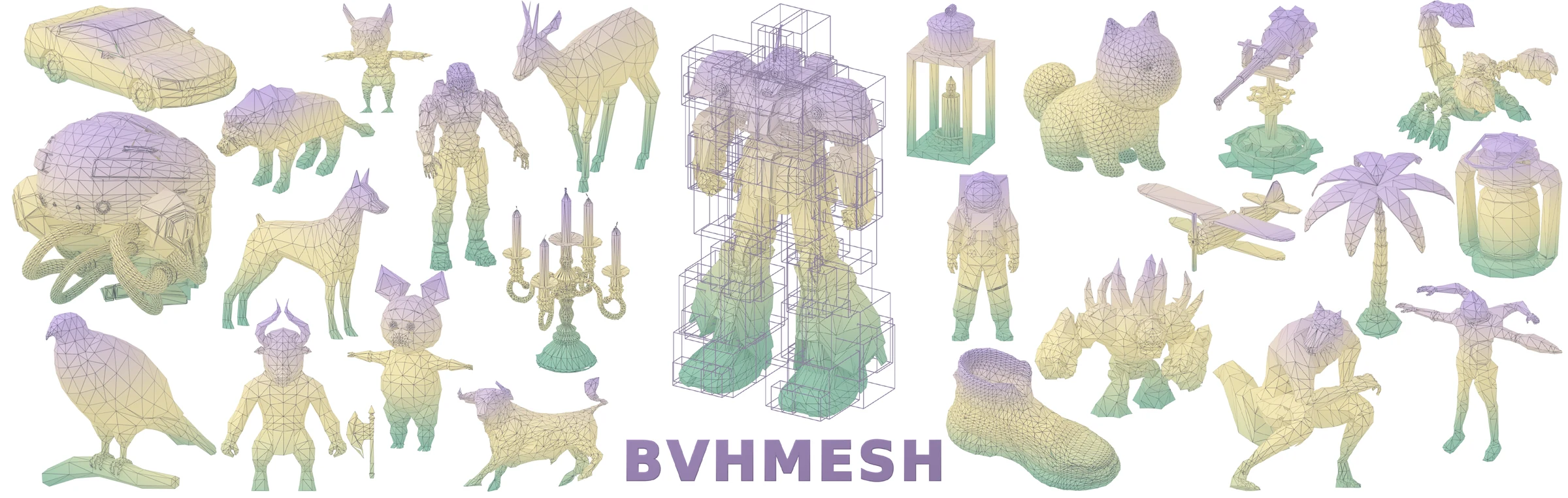
Gallery of artist-style 3D meshes generated by BVHMesh, with an octree-aligned bounding volume hierarchy drawn around the central robot.

Explanatory Video

Method Video

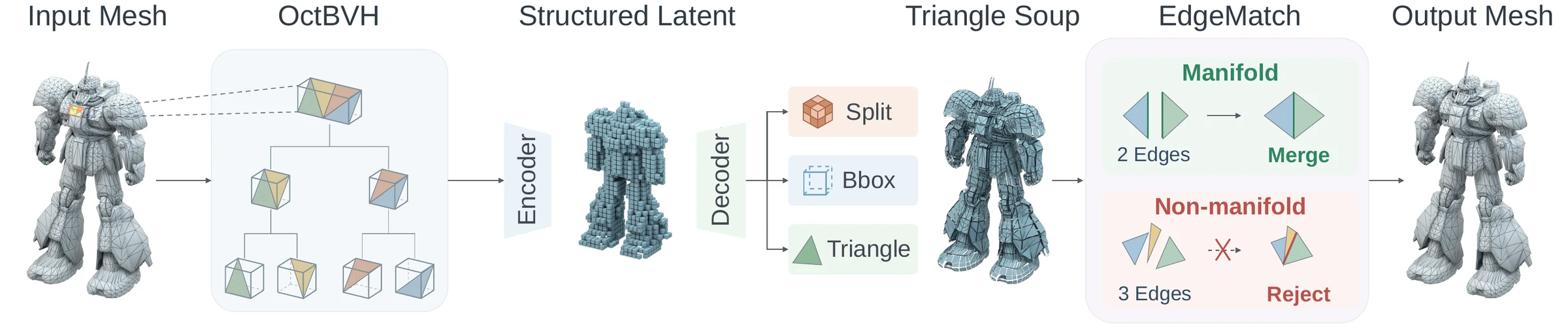
BVHMesh organizes triangles into an OctBVH with hierarchical local frames, encodes them into structured latents, decodes independent triangles, and stitches them into a manifold mesh with EdgeMatch.

Overview

Abstract

Artist-style meshes are compact and editable, yet generating their continuous geometry alongside irregular discrete connectivity efficiently remains challenging. Field-based methods extract dense, topology-agnostic tessellations, whereas autoregressive methods generate compact meshes directly but decode faces sequentially. Recent flow-based methods generate vertices in parallel and recover faces from predicted pairwise connectivity, where missing or spurious edges can propagate into holes, redundant faces, and non-manifold surfaces.

We introduce BVHMesh, a face-first flow-based framework that decodes explicit triangles in parallel and stitches them into a clean mesh. To make parallel triangle prediction tractable, we organize triangles in an octree-aligned bounding volume hierarchy (OctBVH): nested bounding boxes supply coarse-to-fine local coordinate frames, while octree alignment enables efficient sparse convolutions across the hierarchy. A hierarchical VAE and two-stage conditional flow matching generate triangle soups from pointclouds or single images.

EdgeMatch then recovers mesh connectivity through learned one-to-one half-edge matching with explicit topological checks against non-manifold edges, duplicate faces, and collapsed triangles. On the held-out Toys4K benchmark, BVHMesh achieves state-of-the-art VAE reconstruction and artist-mesh generation under both pointcloud and image conditioning, achieving 0.00% non-manifold edges in pointcloud-conditioned generation (versus 11.50% for MeshFlow) while maintaining ~15 s inference even beyond 10,000 faces.
Motivation

Why Face-First Mesh Generation?

Vertex-first methods infer faces from predicted edges, so one wrong edge can open a hole or add a redundant surface. Face-first generation needs only one-to-one half-edge matching.

Vertex-First · Many-to-Many

Faces must be inferred from edges

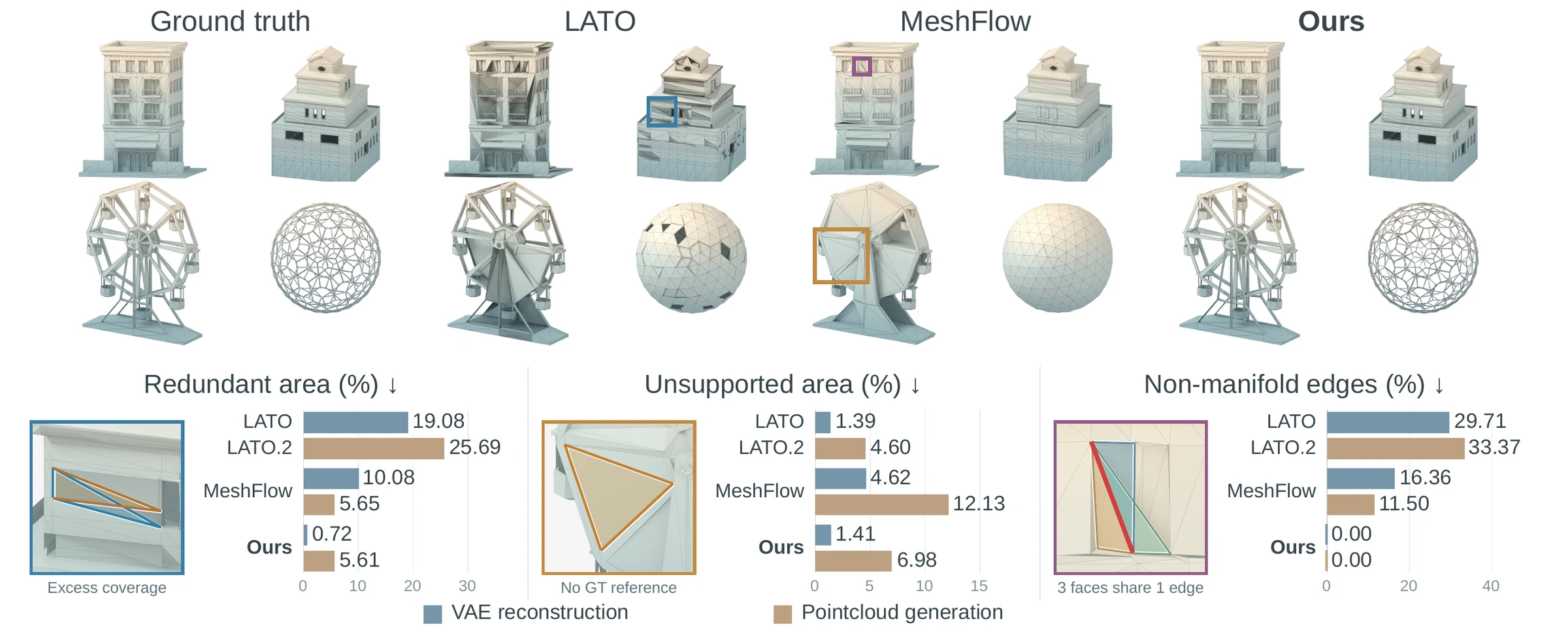
Vertex-first methods such as MeshFlow and LATO predict vertices and the edges between them, then extract triangles from the resulting graph. Because vertex degrees vary, edge prediction is a many-to-many problem, and face extraction cannot enforce valid topology: a missing edge can drop its adjacent faces, while a spurious edge forms extra triangles with every vertex connected to both endpoints, producing redundant surfaces and non-manifold edges.

Face-First · Partial One-to-One

Faces are explicitly generated

Generating triangles directly fixes the three corners of every face, so what remains is to find which faces share an edge. In a manifold mesh, each half-edge has at most one partner, and boundary half-edges have none. Connectivity recovery thus becomes partial one-to-one matching, and each merge is rejected if it would create a non-manifold edge, a duplicate face, or a collapsed triangle.

Comparison of face-first and vertex-first methods on held-out examples and Toys4K topology metrics.
Face-first vs. vertex-first mesh generation. Top: VAE reconstructions on held-out shapes, where colored boxes highlight redundant surfaces, unsupported surfaces, and non-manifold edges. Bottom: enlarged artifact regions and dataset-averaged metrics on Toys4K. Vertex-first baselines spuriously fill openings in thin structures such as the Ferris wheel and lattice sphere, whereas BVHMesh preserves these openings. In VAE reconstruction, BVHMesh achieves 0.00% non-manifold edges and 0.72% redundant area, compared with 10.08% redundant area for MeshFlow and 19.08% for LATO.

Pipeline

BVHMesh Architecture

Flow matching following TRELLIS.2 generates OctBVH latents, the hierarchical decoder produces triangle soups, and EdgeMatch stitches them into manifold meshes.

Overview of the BVHMesh pipeline from input mesh to OctBVH, structured latent, decoder heads, triangle soup, EdgeMatch, and output mesh.
Overview of BVHMesh VAE and stitching pipeline. An input mesh is organized into an OctBVH and compressed into structured latents at 643 resolution. The hierarchical decoder predicts octree splits, quantized parent-relative bounding boxes, and continuous leaf triangles to form a triangle soup, which EdgeMatch stitches into a manifold mesh.
01

Two-Stage Flow Sparse structure & latents

Conditioned on an input pointcloud or image, flow-matching models sample 643 occupied triangle-centroid voxels followed by 32-channel structured OctBVH latents.

02

OctBVH Decoder Coarse-to-fine local frames

Across octree depths 6 to 9 (5123), OctFormer blocks predict 8-child occupancy splits, quantized parent-relative boxes (Q = 64), and continuous leaf-frame triangles.

03

Corner & Edge Heads Denoising & correspondence

An OctBVH U-Net refines triangle corner positions and evaluates both parallel (s∥) and crossed (s×) endpoint correspondences on KNN candidate half-edge pairs.

04

Constrained Merge Blossom + topology checks

Blossom proposes global one-to-one half-edge pairs; incremental union-find commits each merge only if it introduces no collapsed, duplicate, or non-manifold faces.

Detailed diagrams of OctBVH hierarchical coordinates, half-edge endpoint correspondence scoring, and rejected topological merges.
Details of OctBVH coordinates and EdgeMatch constraints. (a) Octree built over triangle centroids (left), quantized child bounding boxes in the parent frame (middle), and continuous triangle coordinates inside each leaf box (right). (b) Scoring the two possible endpoint correspondences between candidate half-edges. (c) Explicit rejection of merges that would cause collapsed faces, non-manifold edges, or duplicate faces.

Evaluation

Quantitative Comparisons

On the held-out Toys4K benchmark, BVHMesh achieves the best artist-mesh results in pointcloud-conditioned generation, VAE reconstruction, and image-conditioned generation.

Table 1. Pointcloud-conditioned generation on Toys4K.
MethodCD ↓HD ↓NC ↑
MeshAnythingV272.68344.20.745
BPT17.72112.60.902
TreeMeshGPT18.93124.20.884
DeepMesh30.47169.40.855
MeshRipple22.68144.70.875
FastMesh30.31173.20.830
MeshFlow11.1772.60.893
LATO.29.0269.70.900
BVHMesh (Ours)8.2964.70.941
Table 2. Mesh VAE reconstruction on Toys4K.
MethodCD ↓HD ↓NC ↑
MeshGPT28.91163.20.882
TRELLIS8.5577.00.938
PivotMesh12.3256.30.901
MeshFlow8.1440.50.940
LATO5.6653.50.965
BVHMesh (Ours)4.7525.80.972

Chamfer Distance (CD, L1) and Hausdorff Distance (HD) are scaled by 103. Best artist-mesh results are highlighted in blue.

Table 3. Image-conditioned generation on Toys4K. Field-based rows are dense-mesh references rather than artist-mesh competitors.
Method Geometry Image Agreement FID ↓ #Faces
CD ↓HD ↓NC ↑ ULIP ↑Uni3D ↑
Field-based image-to-3D (dense iso-surface references)
TRELLIS58.12278.40.7590.29770.23879.79551,609
TRELLIS.252.86252.70.7760.31240.26788.056,605,189
TRELLIS dense mesh → artist mesh
MeshFlow60.36282.10.7510.28200.228424.571,265
BPT108.50449.10.6830.23690.193524.112,106
Native topology generation
LATO.258.74293.20.7380.26470.176227.668,626
BVHMesh (Ours)53.54263.80.7610.29210.231422.895,965

Analysis

Ablation Studies & Inference Efficiency

Local frames with discrete boxes and continuous triangles drive reconstruction quality, while one-to-one matching, topology checks, and learned heads make stitching precise.

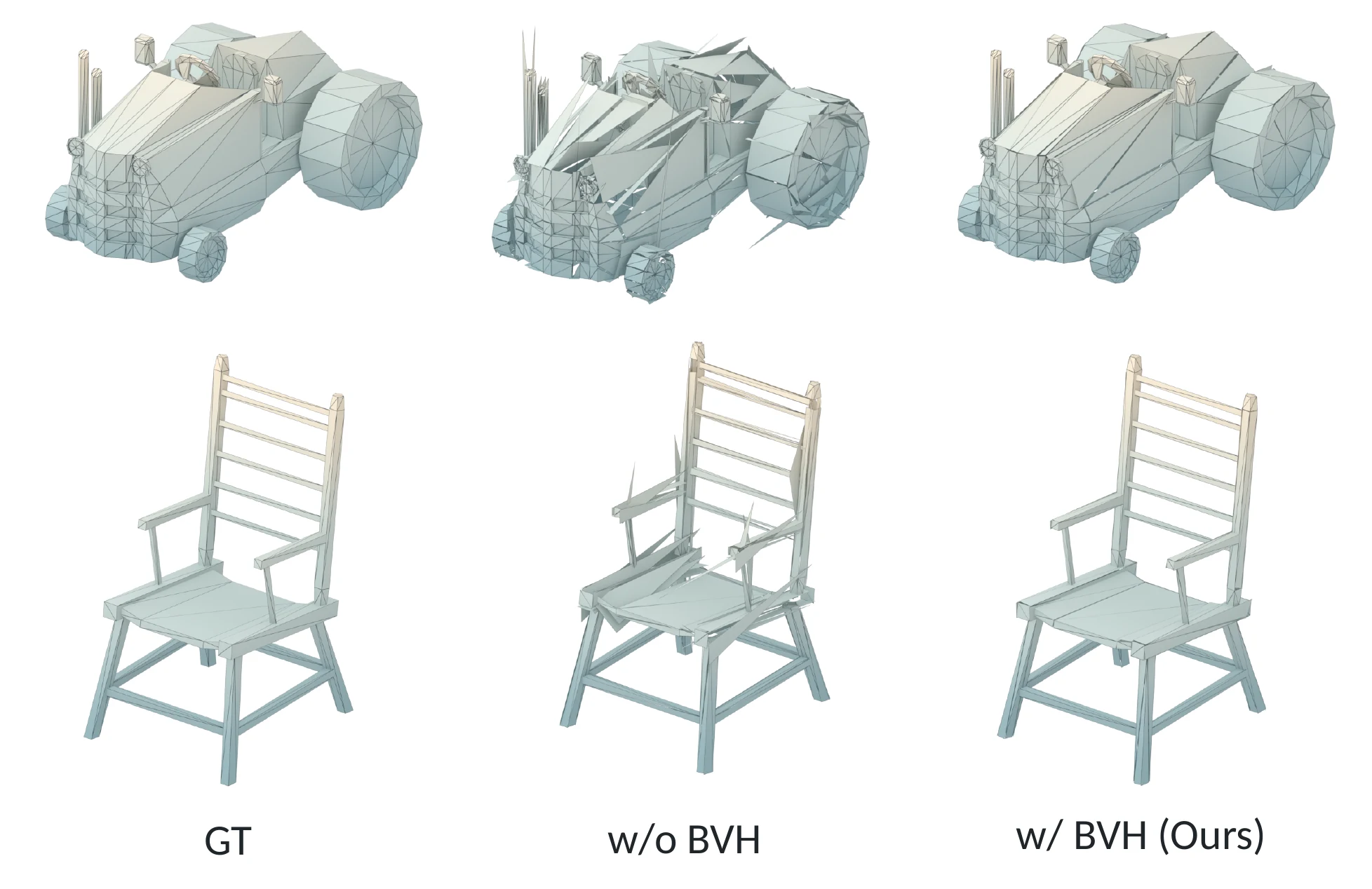
Ablation of OctBVH on VAE reconstruction of a tractor and chair.
OctBVH representation ablation. Left: ground truth. Middle: w/o OctBVH (predicting discrete global triangle coordinates on the same octree backbone). Right: full OctBVH with quantized parent-relative boxes and continuous leaf triangles.
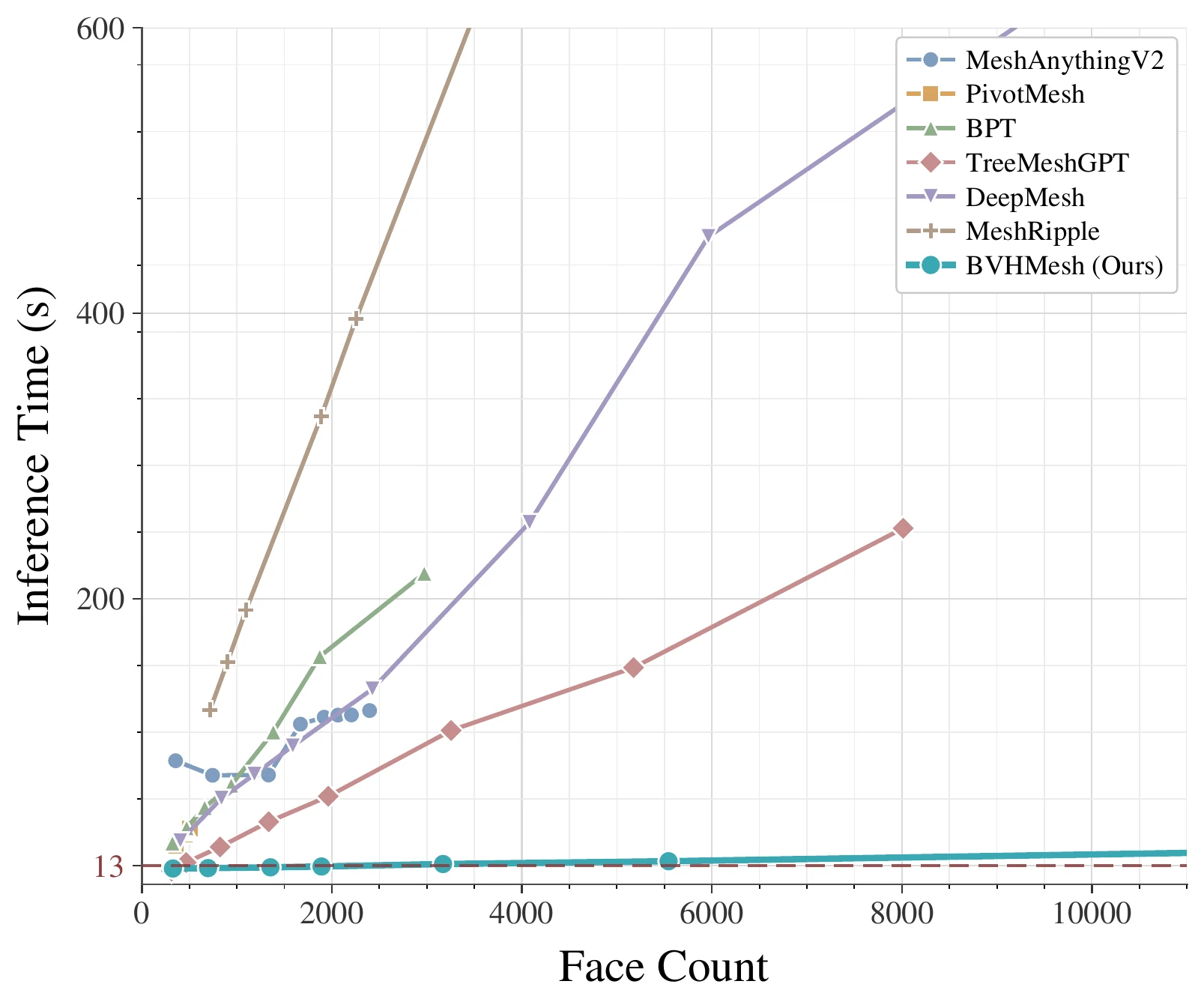
Inference runtime scaling across face counts compared with autoregressive mesh generators.
Inference runtime vs. face count. Sequential autoregressive decoders slow down sharply as face count increases, whereas BVHMesh decodes in parallel and stays near ~15 s per mesh even beyond 10,000 faces (RTX 5090, batch size 1).
Table 4. Ablation of OctBVH local frames and coordinate quantization, evaluated on decoded triangle soups prior to EdgeMatch.
RepresentationBounding-Box Coords.Triangle Coords.CD ↓HD ↓NC ↑
w/o OctBVH–Discrete42.94268.00.828
w/o OctBVH–Continuous35.27235.80.706
w/ OctBVHContinuousContinuous23.41132.50.807
w/ OctBVHDiscreteDiscrete17.04126.10.871
w/ OctBVH (Ours)DiscreteContinuous4.9529.70.971
Table 5. Cumulative ablation of EdgeMatch components on perturbed Toys4K triangle soups across three Gaussian noise levels σ. P/R/F1 denote half-edge matching precision, recall, and F1 (%).
Variant σ = 0.004 σ = 0.012 σ = 0.020
CD↓NC↑HD↓P↑R↑F1↑ CD↓NC↑HD↓P↑R↑F1↑ CD↓NC↑HD↓P↑R↑F1↑
Distance welding34.550.888242.037.499.847.818.800.878126.638.143.433.616.200.81788.227.16.68.0
+ One-to-one match4.420.96723.488.688.888.78.360.90546.958.657.257.913.800.84669.640.130.134.3
+ Topology checks4.360.97017.291.586.989.07.590.90736.663.454.058.213.440.83268.443.327.933.9
+ Blossom4.330.97017.092.088.790.27.330.91035.463.856.359.713.410.83468.143.128.534.3
+ Matching head4.170.97415.896.694.995.76.090.93925.581.476.778.911.640.87562.466.151.557.8
+ Denoising head (Full)4.160.97615.996.094.195.05.340.96121.981.475.178.07.330.94133.166.357.161.2

Applications

Scene- & City-Level Mesh Generation

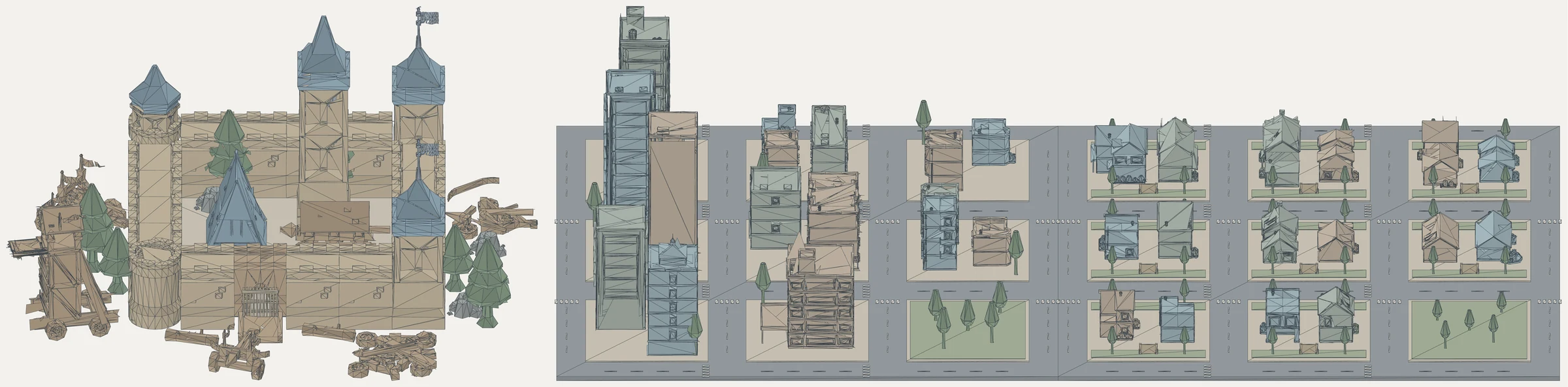
Compact face counts and fast parallel decoding let BVHMesh generate modular assets and land parcels independently, then assemble them into large artist-style environments.

Scene-level mesh generation of a medieval castle and commercial and suburban neighborhoods.
Modular scene generation. Conditioning on pointclouds sampled from Kenney kit layouts produces coherent artist-style components assembled into a castle (left) and adjoining commercial and suburban neighborhoods (right).
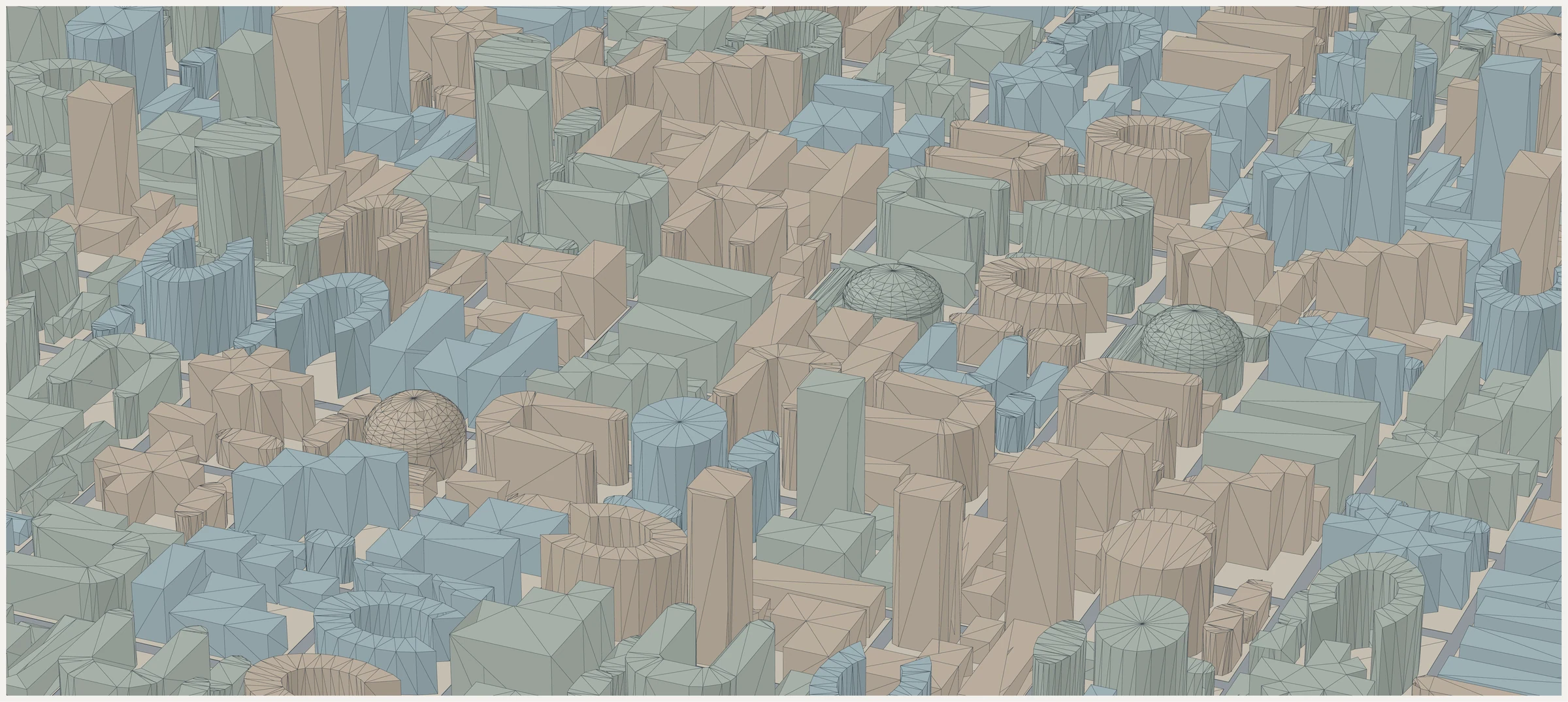
City-level mesh generation across 224 land parcels from procedural OSM2World layouts.
City-level generation. Generating individual land parcels conditioned on procedural OSM2World pointclouds yields a full-scale multi-block city mesh with clean architectural geometry.